
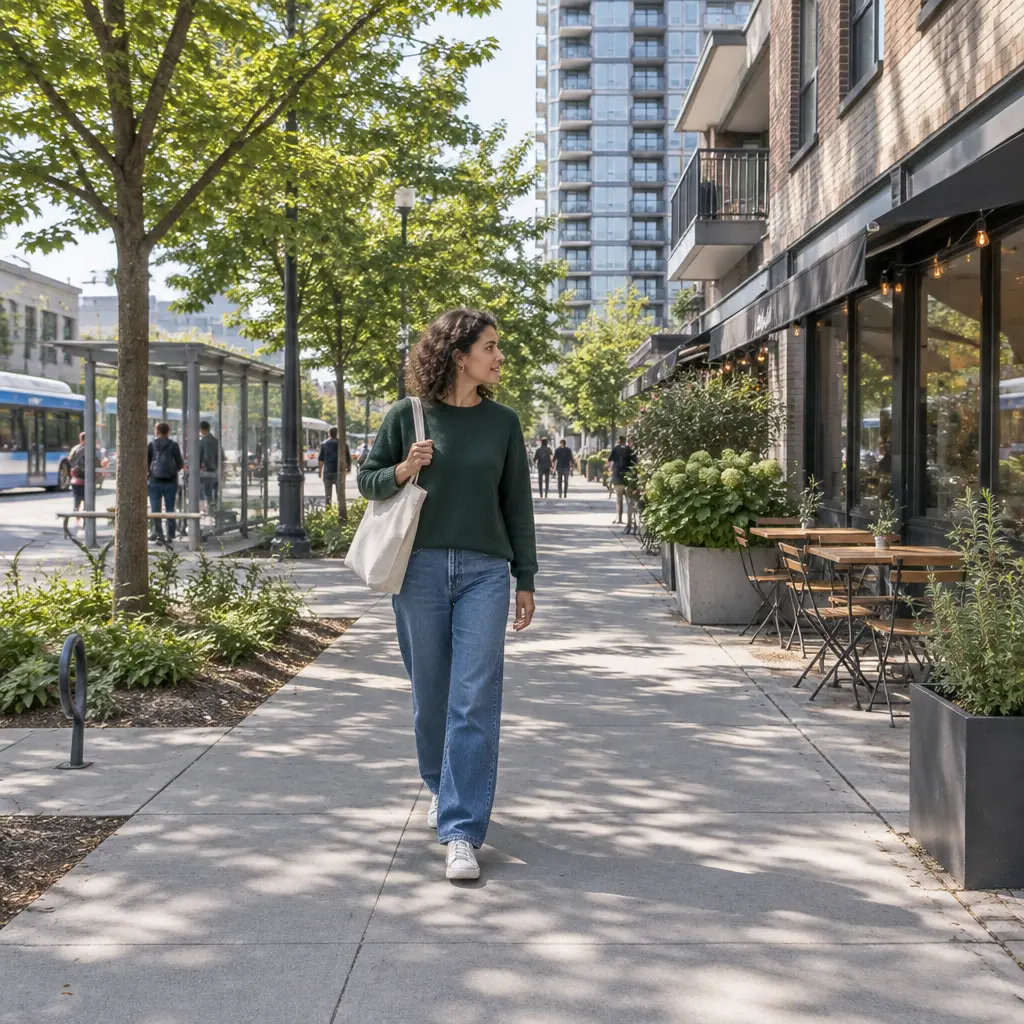
A great neighborhood for luxury condos is one that combines convenient access, personal safety, high-quality public spaces, strong everyday services, and a setting that supports lasting value. The Urban Land Institute’s research on walkability and the U.S. Environmental Protection Agency’s guidance on location-efficient development both point to the importance of access to destinations and transportation—not just the quality of a building. For buyers, that means assessing transit and walkability, safety and services, parks and cultural amenities, and resilience alongside architecture and finishes. No single neighborhood feature guarantees investment performance, but together these conditions shape daily experience and help explain why location is central to a luxury home’s appeal.
Walkability and Transit Access Define a Luxury-Ready Neighborhood
Walkability describes how easily people can reach useful destinations on foot; transit access measures how conveniently they can connect to reliable public transportation. The U.S. Environmental Protection Agency describes location-efficient neighborhoods as places where residents can reach destinations by walking, cycling, or transit, potentially reducing dependence on driving. For a luxury condo, this combination supports convenience, mobility, and a more connected daily routine.
Daily Needs Within Walking Distance
A walkable neighborhood places groceries, cafés, pharmacies, fitness facilities, and other regular services within a comfortable walk. The details matter: attractive streets, well-maintained sidewalks, safe crossings, shade, and active ground-floor businesses can make a short trip more practical than a similar-distance route through blank walls or traffic-heavy intersections. The National Association of Realtors’ 2023 Community and Transportation Preferences Survey found that 79% of respondents considered being within an easy walk of places important. That figure reflects broad consumer preferences, not luxury-condo buyers alone, but it helps explain why walkability can strengthen a home’s everyday appeal.
Transit Connections and Regional Reach
Strong transit access gives residents alternatives to driving and connects a neighborhood to employment centers, airports, universities, and cultural districts. Buyers should consider the distance to stations, service frequency, operating hours, accessibility, and whether routes make useful connections—not simply whether a transit stop appears on a map. The American Public Transportation Association reported that public transportation in the United States recorded 7.7 billion trips in 2023, illustrating the scale of its role in urban mobility. That national total does not establish the value of any individual property, but it underscores why dependable transit can be a meaningful neighborhood asset.
Safety and Essential Services Support Residential Quality
Neighborhood safety is not one statistic; it is a combination of personal security, street design, emergency readiness, and residents’ lived experience. Essential services—including healthcare, schools, sanitation, and reliable utilities—also affect how comfortably a household can function. Because conditions vary block by block and change over time, buyers should evaluate multiple sources and visit at different hours rather than relying on a single rating or anecdote.
Street Safety and Public-Realm Design
A safe public realm includes well-lit routes, visible entrances, maintained sidewalks, clear crossings, and streets designed to manage vehicle speeds. The Centers for Disease Control and Prevention’s pedestrian-safety guidance emphasizes measures such as safer street design and improved visibility. Buyers can observe lighting, traffic behavior, building activity, and the condition of public spaces, then compare those impressions with local crime data and municipal safety plans. Crime data should be interpreted carefully because reporting practices and boundaries differ, and an area-wide figure may not reflect a particular block.
Healthcare, Schools, and Reliable Infrastructure
Access to hospitals, clinics, schools, emergency services, and dependable utilities contributes to neighborhood resilience and convenience. Infrastructure quality may be less visible than a skyline view, yet power reliability, drainage, road maintenance, and emergency access can have a direct impact on daily life. The Federal Emergency Management Agency’s National Risk Index provides county- and census-tract-level information on natural-hazard risk, while local governments publish details on evacuation routes and infrastructure projects. These tools help buyers ask informed questions, but a risk index should not substitute for a property-specific inspection or insurance review.
Parks and Cultural Amenities Enrich the Condo Lifestyle
Parks, waterfronts, restaurants, museums, theaters, and public gathering places give a neighborhood character beyond its buildings. These amenities can support recreation and social life, while also making a location more attractive to a wider range of residents. Their value depends on access, quality, programming, upkeep, and whether they remain enjoyable throughout the year.
Green Space and Outdoor Access
Green space includes public parks, gardens, trails, tree-lined streets, and accessible waterfronts. The Trust for Public Land’s ParkScore index evaluates park systems using factors including acreage, access, investment, and amenities. Its 10-minute-walk standard is a useful screening concept: it asks whether residents can reach a public park in roughly ten minutes on foot, rather than merely measuring total park acreage across a city. Buyers should also check whether nearby spaces are open to the public, well maintained, and suited to their needs.
Dining, Culture, and Neighborhood Identity
A strong cultural environment offers a mix of restaurants, independent businesses, galleries, performance venues, and community events. This variety can create a more distinctive sense of place than a district designed around a single use. The National Endowment for the Arts has documented how arts and cultural activity contributes to community life, although cultural presence alone does not guarantee property appreciation. For a prospective buyer, useful indicators include year-round programming, diverse local businesses, and public spaces that feel active without becoming uncomfortably congested.
Resilience and Market Fundamentals Shape Long-Term Appeal
A luxury neighborhood’s long-term appeal depends not only on lifestyle but also on its capacity to manage environmental risks and sustain a healthy local economy. Buyers can assess hazards, building and infrastructure investment, housing supply, employment access, and local planning. These factors do not predict a specific condo’s future price, but they provide a more complete framework for evaluating the location.
Climate and Environmental Resilience
Environmental resilience is a community’s ability to prepare for, withstand, and recover from hazards such as flooding, extreme heat, wildfire, or storms. FEMA’s National Risk Index offers a comparative screening tool, while the National Oceanic and Atmospheric Administration’s sea-level tools help users explore coastal exposure. Buyers should also review local flood maps, building elevation, drainage, backup power, insurance availability, and condominium association plans. A neighborhood-level map is only an initial check: risks can differ sharply from one parcel or building to another.
Economic Vitality and Responsible Market Evaluation
Economic vitality refers to the strength and diversity of local employment, businesses, public investment, and services. A neighborhood supported by more than one industry may be less exposed to a single employer or sector downturn, while a pipeline of planned construction can change both amenities and housing supply. The U.S. Census Bureau’s American Community Survey provides local data on commuting, housing, and household characteristics; municipal planning documents can clarify proposed changes. Buyers should compare recent sales, condo fees, reserves, taxes, and rental rules with neighborhood conditions rather than treating prestige or a headline price as proof of value.
How to Evaluate a Neighborhood Before Buying
A structured review helps buyers distinguish a compelling address from a polished marketing description. The following checklist brings together access, services, amenities, and risk factors:
- Walk the immediate area at different times and assess sidewalks, crossings, lighting, noise, and street activity.
- Test real routes to transit, groceries, healthcare, work, and cultural destinations, including service frequency and travel time.
- Review local safety information alongside direct observations and conversations with residents or nearby businesses.
- Check public parks and amenities for access, upkeep, operating hours, and year-round usefulness.
- Consult official hazard maps and local resilience plans, then obtain building-specific inspections and insurance estimates.
- Compare market data and condominium documents, including reserves, assessments, maintenance obligations, and rules that may affect use.
For example, a high-rise in a downtown district may offer rapid transit, dining, and cultural venues, while a waterfront tower may provide open space and views but require closer review of flood exposure and insurance. These are not universal trade-offs: the best choice depends on a buyer’s priorities and on verified, property-specific information.
Conclusion
A great neighborhood for luxury condos balances walkability and transit access with safety, essential services, parks, culture, and environmental resilience. These qualities make a location more useful and enjoyable in the present, while economic vitality and careful market analysis help buyers think beyond the immediate purchase. The strongest decision combines on-the-ground visits with credible public data and a thorough review of the condominium itself. Before committing, compare neighborhoods against your own priorities, consult local planning and hazard resources, and seek qualified real-estate, inspection, and insurance advice.
Sources: U.S. Environmental Protection Agency, Smart Growth and Transportation, https://www.epa.gov/smartgrowth; National Association of Realtors, 2023 Community and Transportation Preferences Survey, https://www.nar.realtor/research-and-statistics/research-reports/nar-community-and-transportation-preferences-surveys; American Public Transportation Association, 2024 Public Transportation Fact Book, https://www.apta.com/research-technical-resources/transit-statistics/public-transportation-fact-book/; Centers for Disease Control and Prevention, Pedestrian Safety, https://www.cdc.gov/transportation-safety/about/pedestrian-safety.html; Federal Emergency Management Agency, National Risk Index, https://hazards.fema.gov/nri/; Trust for Public Land, ParkScore, https://www.tpl.org/parkscore; National Endowment for the Arts, Arts and Cultural Production Satellite Account, https://www.arts.gov/impact/research/arts-data-profile-series; National Oceanic and Atmospheric Administration, Sea Level Rise Viewer, https://coast.noaa.gov/slr/; U.S. Census Bureau, American Community Survey, https://www.census.gov/programs-surveys/acs

