
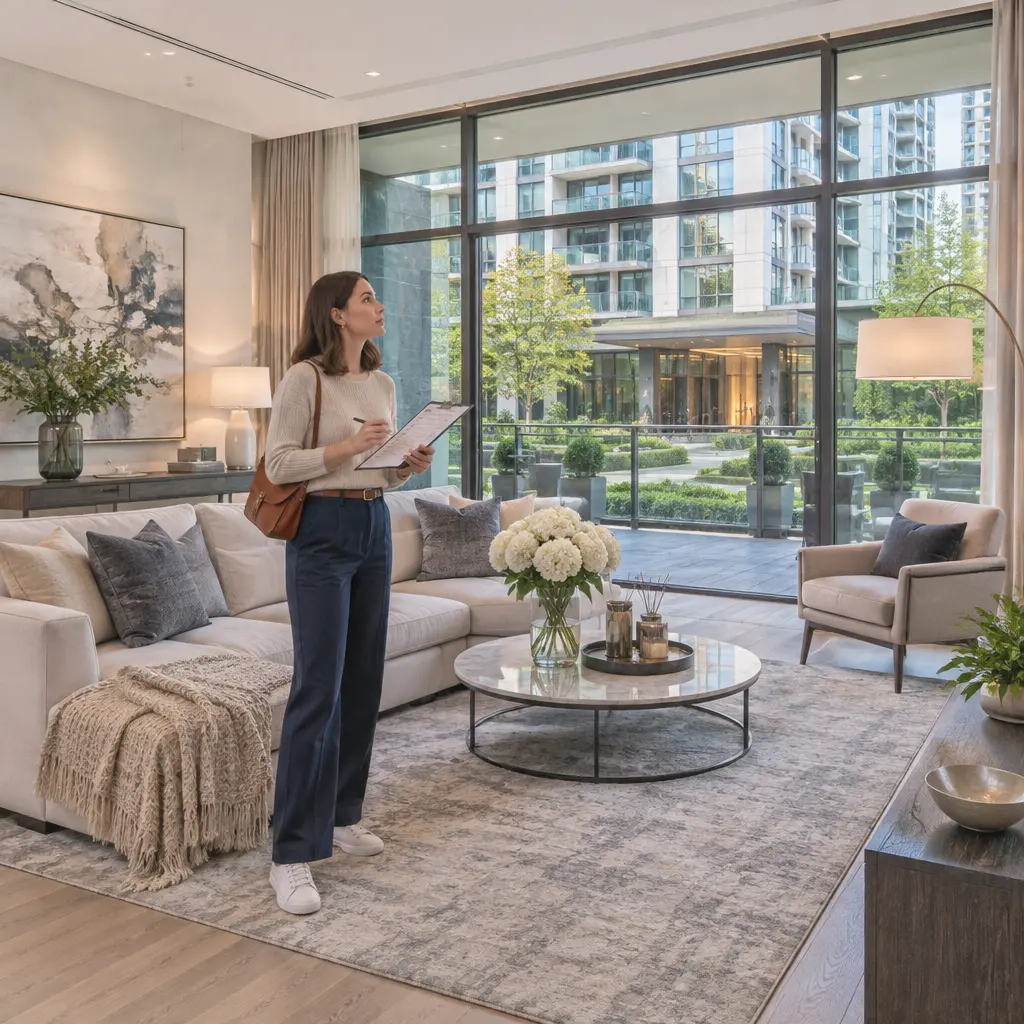
A luxury condo tour is a structured inspection of a high-end condominium’s home, building, and ownership costs—not just a look at finishes and views. To tour like a pro, compare properties using the same checklist, test essential systems, ask for building and financial records, and verify what the purchase price does and does not include. These steps matter in a market where the National Association of Realtors reported a median existing-condo and co-op price of $371,500 in 2024, while luxury pricing varies widely by location, services, and amenities.
Luxury Condo Tours: A Due-Diligence Framework
A luxury condominium combines private ownership of an individual unit with shared ownership or use of common areas governed by a condominium association. The National Association of Realtors describes condominium ownership as a form of ownership in which residents own their units and share responsibility for common elements. A professional tour therefore evaluates three connected layers: the unit itself, the building and its management, and the legal and financial obligations attached to ownership.
This distinction is important because attractive interiors cannot reveal an association’s reserve position, pending assessments, insurance limitations, or maintenance plans. The Community Associations Institute estimates that about 74.2 million Americans live in community associations, including condominiums and homeowners associations, underscoring how common shared governance is. Treat a showing as the start of verification, not as a substitute for reviewing disclosures and professional inspections.
Prepare a comparable-tour checklist
Before visiting, define priorities such as location, usable space, privacy, accessibility, service level, parking, and monthly carrying cost. Use the same scorecard at each property so a dramatic lobby or staging does not overshadow practical differences. Record the unit’s asking price, interior area, outdoor area, monthly common charges, property taxes, included utilities, parking terms, and any known assessment.
- Separate confirmed facts from claims that still need documents or independent verification.
- Ask whether listed area is measured consistently and whether terraces, storage, or parking are included in the quoted figure.
- Request the condominium declaration, bylaws, rules, recent meeting minutes, budget, reserve information, and insurance summary when available.
- Bring a phone or camera, a small flashlight, and a measuring tool, while respecting the seller’s privacy and showing instructions.
Inspect the unit beyond its finishes
A unit inspection is a practical review of visible condition, function, comfort, and potential maintenance needs. Look closely at windows, doors, flooring transitions, ceilings, plumbing fixtures, appliances, ventilation, and evidence of past leaks or repairs. Open and close windows and cabinets where permitted; test water pressure and drainage; and note unusual odors, temperature differences, or noise from neighboring units and mechanical equipment.
Ask which appliances and fixtures are included in the sale, how old major systems are, and whether renovations were permitted and documented. The U.S. Environmental Protection Agency notes that indoor air quality can be affected by sources such as moisture, combustion, and inadequate ventilation. A tour cannot diagnose air-quality problems, but visible condensation, persistent musty smells, or poor bathroom exhaust are reasonable prompts for follow-up questions and, when warranted, expert assessment.
Evaluate layout, light, privacy, and sound
A floor plan is the arrangement of rooms and circulation space, while livability is how that arrangement supports daily routines. Check whether bedrooms have practical furniture walls, whether storage is adequate, and whether the route from entry to kitchen and living areas works for you. Visit at different times if possible: daylight, traffic, construction, and neighboring activity can vary substantially by hour.
Pay attention to window orientation, views that may be obstructed by future development, elevator proximity, and shared walls. Ask whether windows are operable and what sound-control measures the building uses. A short showing is only a snapshot, so record questions rather than assuming a quiet or bright moment represents typical conditions.
Building Amenities and Services: Verify the Operating Reality
Condominium amenities are shared facilities or services—such as a concierge, fitness room, pool, parking, package handling, or outdoor space—provided under building rules and funded through operating expenses or user fees. Their value depends on availability, condition, operating hours, staffing, and cost, not simply on their presence in marketing materials. The Institute of Real Estate Management emphasizes the role of professional property management in maintaining buildings and coordinating services; during a tour, assess whether the actual operation matches the promised experience.
Inspect common areas and service quality
Common areas are spaces shared by residents, including lobbies, corridors, elevators, garages, and recreational facilities. Observe cleanliness, lighting, signs of deferred maintenance, access controls, and the condition of equipment. Ask who manages the building, whether staff are employees or contractors, and how residents report maintenance issues.
For each amenity, confirm operating hours, reservation rules, guest policies, fees, and planned closures. A pool or fitness center may be attractive but less useful if access is limited or repairs are pending. If the building offers valet, storage, or housekeeping, establish whether those services are included in common charges or billed separately.
Check access, safety, and emergency readiness
Building safety review means checking visible safeguards and asking how emergency procedures are managed; it is not a substitute for a code inspection. Note controlled entry, visitor procedures, fire alarms, visible sprinkler equipment, emergency exits, and posted evacuation information. Ask where residents receive emergency notices and whether the association has plans for outages, severe weather, or elevator failures.
The National Fire Protection Association identifies smoke alarms and properly maintained fire-protection systems as important parts of home fire safety. Do not test alarms or access restricted areas during a showing. Instead, request relevant inspection or maintenance records and consult local authorities or qualified professionals about jurisdiction-specific requirements.
Condo Association Finances and Documents: Assess the Hidden Costs
Condominium due diligence is the review of governing documents, budgets, reserves, insurance, meeting records, and known projects to understand the risks and obligations of ownership. The Consumer Financial Protection Bureau advises homebuyers to consider costs beyond the mortgage, including taxes, insurance, and other recurring expenses. For a condo, common charges and possible special assessments are also central to the monthly and long-term cost picture.
Understand common charges and reserve funding
Common charges are regular payments collected by the association to operate and maintain shared property. Ask for the current budget, recent financial statements, reserve study if one exists, and history of charge increases. A reserve fund is money set aside for major future repairs and replacements; its adequacy depends on the building’s age, systems, maintenance needs, and planned projects, so a balance alone does not tell the whole story.
Clarify exactly what charges cover, such as heat, water, staff, insurance for common areas, or amenities. Then build a monthly estimate that includes mortgage, taxes, unit insurance, utilities, parking, and likely maintenance. The National Association of Realtors’ 2024 median price for existing condo and co-op homes was $371,500, but a national median cannot predict the total cost of a particular luxury property; local taxes, association budgets, and services can change the calculation materially.
Investigate assessments, repairs, and insurance
A special assessment is an additional charge levied by an association, often to fund expenses that routine revenue or reserves cannot cover. Ask whether any assessment is proposed, approved, unpaid, or recently completed, and what work it funds. Review board and owner meeting minutes for recurring discussion of leaks, façade work, elevators, plumbing, structural repairs, litigation, or insurance renewals.
The association’s master policy generally insures some shared property and may cover certain building components, while owners typically need separate coverage for personal belongings, improvements, and liability; exact boundaries depend on governing documents and local law. Request the insurance certificate and ask an insurance professional to identify exclusions, deductibles, and any coverage gap. The Federal Emergency Management Agency’s flood-risk resources can help identify area-level flood exposure, but a property-specific insurance review is still necessary.
Review rules, restrictions, and resale considerations
Condominium rules are enforceable requirements governing owners’ use of units and shared spaces. Confirm policies on pets, renovations, rentals, smoking, move-in fees, short-term letting, and exterior changes. If you expect to rent the unit or remodel it, obtain written confirmation of the applicable process and restrictions rather than relying on a verbal summary.
Ask whether the association has pending litigation, whether the building has experienced material insurance or financing difficulties, and whether any planned project could affect residents or resale. These issues do not automatically make a condo unsuitable, but they can affect costs, financing, and future flexibility. Have a real-estate attorney and lender review documents relevant to your transaction and jurisdiction.
A Professional Tour Process: Ask, Record, and Verify
A professional tour process is a repeatable sequence for observing the property, asking targeted questions, recording evidence, and resolving uncertainties before making a decision. The U.S. Department of Housing and Urban Development encourages buyers to understand the homebuying process and seek qualified assistance where appropriate. In practice, the strongest tour combines direct observation with independent review of documents and inspections.
Use a consistent walkthrough sequence
- Start outside: note the street, nearby construction, entrances, transit access, and visible building condition.
- Review the lobby and shared areas: observe access procedures, cleanliness, elevator condition, and amenity upkeep.
- Walk the unit in a fixed order: entry and storage, kitchen, living area, bedrooms, bathrooms, windows, and outdoor space.
- Test only what the agent or owner permits, and record any defect, unusual sound, odor, or unanswered question.
- After the showing, compare the property against your scorecard and request documents that verify important claims.
Ask questions that produce verifiable answers
Open-ended questions reveal context, while document requests help confirm details. For example, ask, “What major work is planned in the next five years?” and follow up by requesting the budget, reserve study, or relevant meeting minutes. Ask what the monthly charge includes, whether it has changed recently, and whether the seller knows of pending assessments or unresolved water issues.
For a real-world comparison, imagine two units with similar prices: one has a larger terrace and a lower monthly charge, while the other has newer elevators and a funded façade project. The first may look like the better deal on tour, but the second could present lower near-term repair uncertainty. The documents—not the staging or a single monthly figure—help establish which trade-off fits the buyer’s priorities.
Know when to bring in specialists
A home inspector evaluates accessible components and reports observed conditions; a structural engineer, electrician, plumber, or environmental specialist may be needed for specific concerns. A real-estate attorney can interpret governing documents, and an insurance professional can review coverage. If the building’s records raise questions about major repairs, financing eligibility, or structural safety, pause and seek qualified advice before waiving relevant protections.
Conclusion: Make the Tour Evidence-Based
Touring a luxury condo like a pro means evaluating the unit, the shared building, and the association’s finances and rules as one connected purchase. A consistent checklist helps compare layout and condition; direct questions clarify amenities and services; and budgets, minutes, insurance records, and inspections help uncover costs that a polished showing cannot reveal. Before committing, verify key claims, estimate the full cost of ownership, and consult qualified professionals for legal, financial, insurance, and technical review. For further preparation, request the association’s current records and review buyer guidance from the Consumer Financial Protection Bureau and your local housing authority.
Sources: National Association of Realtors, Existing-Home Sales Report, 2024 annual median price data, https://www.nar.realtor/newsroom/existing-home-sales-recede-0-7-in-december; Community Associations Institute, Community Association Fact Book, https://foundation.caionline.org/publications/factbook/; U.S. Environmental Protection Agency, Introduction to Indoor Air Quality, https://www.epa.gov/indoor-air-quality-iaq/introduction-indoor-air-quality; Institute of Real Estate Management, About IREM, https://www.irem.org/about-irem; National Fire Protection Association, Smoke Alarms, https://www.nfpa.org/education-and-research/home-fire-safety/smoke-alarms; Consumer Financial Protection Bureau, Owning a Home, https://www.consumerfinance.gov/owning-a-home/; Federal Emergency Management Agency, Flood Map Service Center, https://msc.fema.gov/portal/home; U.S. Department of Housing and Urban Development, Buying a Home, https://www.hud.gov/topics/buying_a_home.


